

To invoice clients in the UAE in a compliant way, agree the terms before you start, include the required details on every invoice, send it on time, correct mistakes with credit notes and keep your records. If you are VAT-registered, your invoices must also meet the tax invoice rules set by the Federal Tax Authority (FTA).
This guide takes you through each step, from agreeing terms to following up on payment, and explains how Dynamic Freelancer members invoice through Dynamic Freelancer Central.
Step 1: Agree the Terms Before You Start
Agreeing the details before work starts prevents many invoicing disputes. Confirm the scope of work, your rate, the currency, when you will invoice and when payment is due.
Put these terms in writing, either in a signed agreement or a confirmed email. If a client questions an invoice later, you can point back to what was agreed.
Step 2: Check Your VAT Position
The UAE has no personal income tax, but VAT applies once your taxable supplies pass the registration threshold, and Corporate Tax applies to individuals whose business turnover exceeds AED 1 million in a calendar year, according to the Ministry of Finance.
Your VAT position decides which type of invoice you issue. VAT registration is mandatory when your taxable supplies and imports exceed AED 375,000 in the previous 12 months, or are expected to in the next 30 days. You can register voluntarily once they exceed AED 187,500, according to the UAE Government VAT guide for businesses.
VAT-registered: you issue tax invoices showing your Tax Registration Number (TRN) and charge VAT at the standard 5% rate unless the zero rate applies.
Not VAT-registered: you issue standard invoices with no VAT and no TRN.
Late registration carries a penalty of AED 10,000, so track your income against the threshold throughout the year. You can read more in our guide on whether freelancers pay tax in the UAE.
Step 3: Include the Right Details on Every Invoice
Every invoice should include:
Your name or business name and contact details
Your client's name and address
A unique, sequential invoice number
The issue date and the date the work was delivered
A description of the services
The amount, currency and any discount
Payment terms, the due date and how to pay
If you are VAT-registered, your invoice must also follow the FTA's tax invoice rules. That means adding the words "Tax Invoice", your TRN, your client's TRN if they are registered, the VAT rate and amount, and the totals in AED.
Step 4: Send Invoices on Time
VAT-registered businesses must issue a tax invoice within 14 days of the date of supply. Missing this deadline can lead to a penalty of AED 2,500 for each detected case.
Even if you are not VAT-registered, invoicing soon after you deliver the work keeps your records in order and your payments on schedule.
Step 5: Invoice Overseas Clients Correctly
You can invoice in another currency, such as US dollars or pounds sterling. If you are VAT-registered, the gross amount and the VAT amount must still be shown in AED, along with the exchange rate used.
VAT-registered freelancers can sometimes charge 0% VAT on services for overseas clients, but the conditions are strict and some services are excluded. Check with a tax adviser before applying the 0% rate, and keep evidence of where each client is based.
Step 6: Correct Mistakes With Credit Notes
Once an invoice is sent, do not edit and resend it. If you need to reduce the amount because of a discount, cancellation or error, issue a credit note that refers to the original invoice.
For VAT-registered businesses, tax credit notes must be issued within 14 days, and late credit notes carry the same AED 2,500 penalty for each detected case.
Step 7: Follow Up on Payment
Track which invoices are paid and which are overdue. When an invoice passes its due date, send a polite reminder that refers to the payment terms you agreed before starting the work.
Our email templates for managing clients include messages you can adapt for payment reminders.
Step 8: Keep Your Records
Keep all invoices, credit notes, agreements and payment records for at least five years from the end of the relevant tax period if you are VAT-registered, or five years from the end of the calendar year if you are not. Corporate Tax records must be kept for seven years, so many businesses keep invoices for seven years to cover both.
The FTA can ask for your records in Arabic. Store files in one place, named consistently, so you can produce them promptly if asked.
Penalties for Getting Invoicing Wrong
The FTA can impose administrative penalties under Cabinet Decision No. 40 of 2017, as amended from 14 April 2026. The amounts below are correct as of 26 October 2026.
Violation | Penalty |
|---|---|
Not issuing a tax invoice within the required period | AED 2,500 for each detected case |
Not issuing a tax credit note within the required period | AED 2,500 for each detected case |
Not keeping the required records | AED 10,000, or AED 20,000 for a repeat within 24 months |
Not registering for VAT on time | AED 10,000 |
E-Invoicing From 2027
The UAE is introducing mandatory e-invoicing for business-to-business and business-to-government transactions, with invoices issued in a structured electronic format through an Accredited Service Provider. Businesses with annual revenue below AED 50 million must start by 1 July 2027, under Ministerial Decision No. 244 of 2025. The Ministry of Finance e-invoicing page has the latest rules.
How Members Invoice Through Dynamic Freelancer Central
As a Dynamic Freelancer member, you invoice your clients through Dynamic Freelancer Central, the member app for managing clients, invoices, documents and payment status in one account. The process has four steps: add the client, submit the engagement details, prepare the invoice and follow the status.
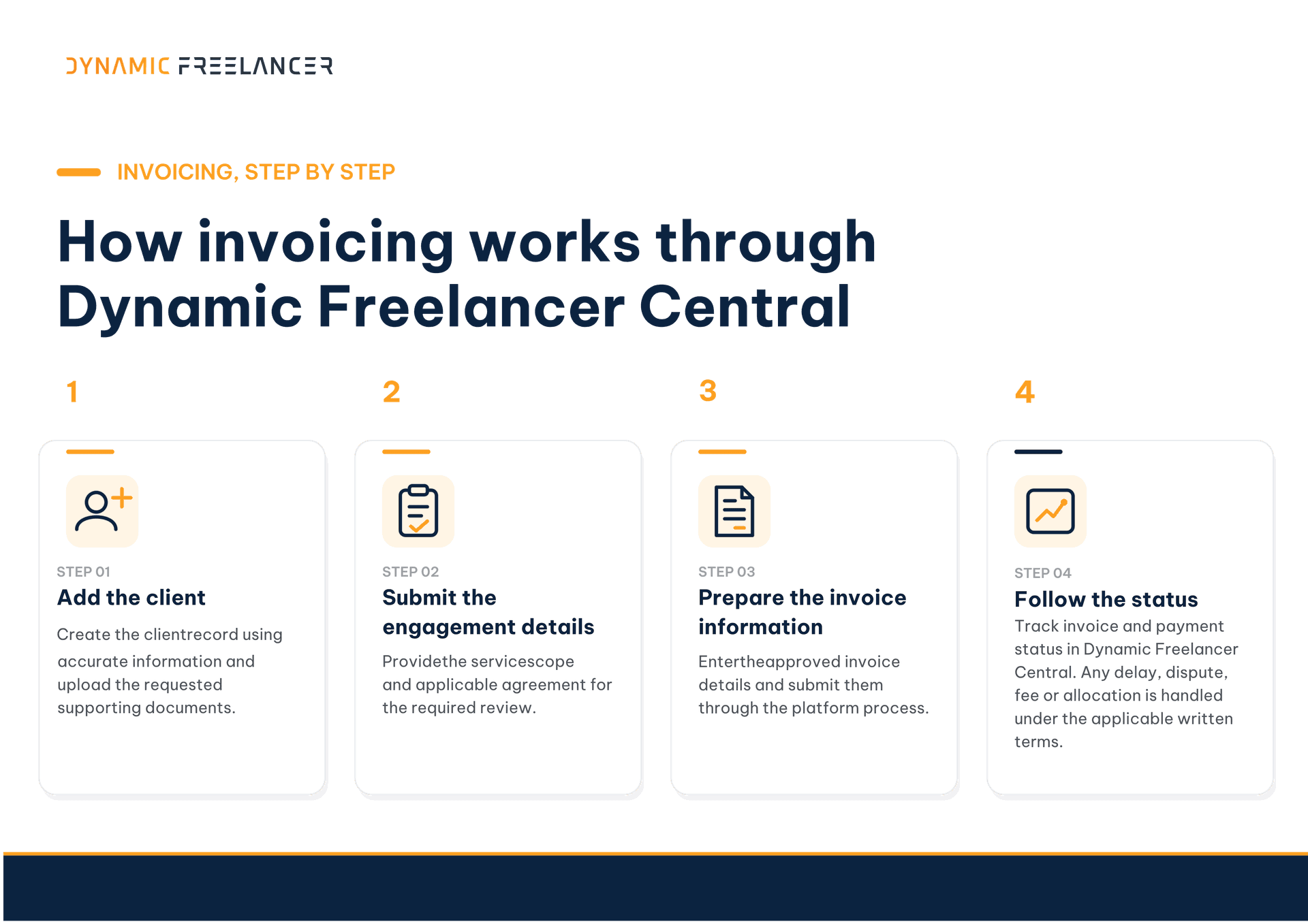
Fees, VAT treatment and terms apply as set out in your service agreement. Read the full Dynamic Freelancer Central guide.
Invoice Your Clients With Confidence
Invoicing clients in a compliant way means agreeing terms first, including the right details, sending invoices on time, correcting mistakes with credit notes, following up on payment and keeping your records. If you are VAT-registered, the tax invoice rules add a few extra details and deadlines.
Dynamic Freelancer gives eligible professionals the structure, tools and support to freelance in the UAE without setting up their own company. See how Dynamic Freelancer works.
Manage Client Invoicing With Confidence
Explore Dynamic Freelancer memberships to see how members manage client records and invoice administration through Dynamic Freelancer Central.
Explore membershipsDynamic Freelancer does not provide tax advice. This article is general information based on UAE legislation in force on 26 October 2026.
Frequently Asked Questions
Find answers to common questions about this topic
Disclaimer: This article is intended to provide practical, up-to-date information. Details may vary based on individual circumstances, location, or changes in regulations. The information provided is for informational and educational purposes only.